The theory
The framework has three moving parts: a capacity axiom (the finite record stage), a cost functional for regional information, and a non-dynamical actuality selector λ that draws the single-world conclusion. (A fourth, earlier part — a conjecture tying two actual records to a capacity overflow — has been withdrawn as a category error; see below. Capacity bounds the number of records, not whether two can be actual.) Only the cost functional’s underlying calculus is machine-verified; the rest is stated honestly as postulate or open.
1. Finite regional capacity (FQ)
A bounded region with boundary area carries a finite information capacity
the holographic / Bekenstein–Hawking bound, with the boundary area of the region and in natural
entropy units (divide by for bits). What QIQT-H postulates is only that the capacity is finite — a
UV-finite record structure (the “Quantized Information” core). This finiteness has two provably-distinct
machine-checked layers: a record count () in the finite-dimensional model, and
a finite entropy bound in the continuum Type III setting — the
EntropyNotCardinality no-go proving the entropy bound is not a count. Finiteness alone gives only
; it does not by itself fix whether scales with area or volume
(a generic finite local cutoff gives volume-scaling maximum entropy — the area law is a fact about vacuum
entanglement, not an automatic property of the capacity). That the bound takes the holographic area form
() is derived — but in a conditional Sakharov / induced-gravity
bridge (assuming local relativistic QFT on a smooth background with a covariant UV cutoff identified with the
finite microstructure), not from finiteness alone: there the area law emerges from the
conical-deficit geometry (the cone curvature is a δ-function on the boundary, whose integral is the area), and the
1/4 is the universal ratio between the conical replica-entropy coefficient and the induced Einstein–Hilbert
coefficient — two quantities sharing one UV coefficient (the ratio machine-checked, sakharov_ratio; the
emergence is the standard Susskind–Uglum/Solodukhin heat-kernel result, Stage B). This is a machine-checked
re-derivation of the standard induced-gravity 1/4 — true and verified, but not unique to finiteness (any
local relativistic QFT with the same UV coefficient yields it). The carried inputs are the
value of (the species/cutoff problem) and, for the full effective action, and
higher-curvature terms.
Update (P4-MICRO, 2026): the area floor is a derived theorem, not a separate postulate. From the
finiteness postulate alone — the region has a finite number of distinguishable microstates, with the
holographic bound supplied by the Sakharov derivation above — the area floor
follows as a one-line corollary of the
elementary maximum-entropy bound , machine-checked and axiom-free
(area_floor_vonNeumann in QIQTH/FQBoundMicro.lean). So the holographic area floor is no longer postulated — it
is a theorem conditional on the finite-capacity postulate. The honest fine print, enforced in the Lean: the bound
is on the von Neumann entropy of the spectrum (not the Shannon entropy of a decohered record law — the two
differ off-diagonally); only the inequality is needed (equality is reserved for the maximally-mixed sector); and
is a finite type-I/code cutoff of the genuinely type-III local algebra, not a global dimension. Feeding
this derived floor into the machine-checked Jacobson construction (gr_from_p4micro in QIQTH/GRFromMicro.lean)
yields the free-field Einstein field equations — but the capacity postulate alone does not give gravity:
a microstate count cannot supply a temperature, so the Bisognano–Wichmann / Unruh thermal input remains a separate
(free-field-discharged) ingredient. The coefficient is the separately-derived Sakharov induced-gravity ratio;
the value of is a carried datum — though it too can be promoted from carried to derived by positing a
fundamental record-granularity scale in place of , giving
(machine-checked axiom-free, InducedNewtonConstant) and consolidating P4-MICRO’s inputs to a single scale; the
numerical value still needs the species accounting. With this induced the granularity capacity also maps onto the holographic dictionary — the boundary Cardy microstate count of a BTZ horizon equals QIQT-H’s bulk capacity exponent (machine-checked, HolographicBridge): a correspondence under the shared , not an import of a boundary CFT or AdS/CFT’s cross-check. Grounding the capacity law itself (replacing the postulate by a modular
identity) remains open.
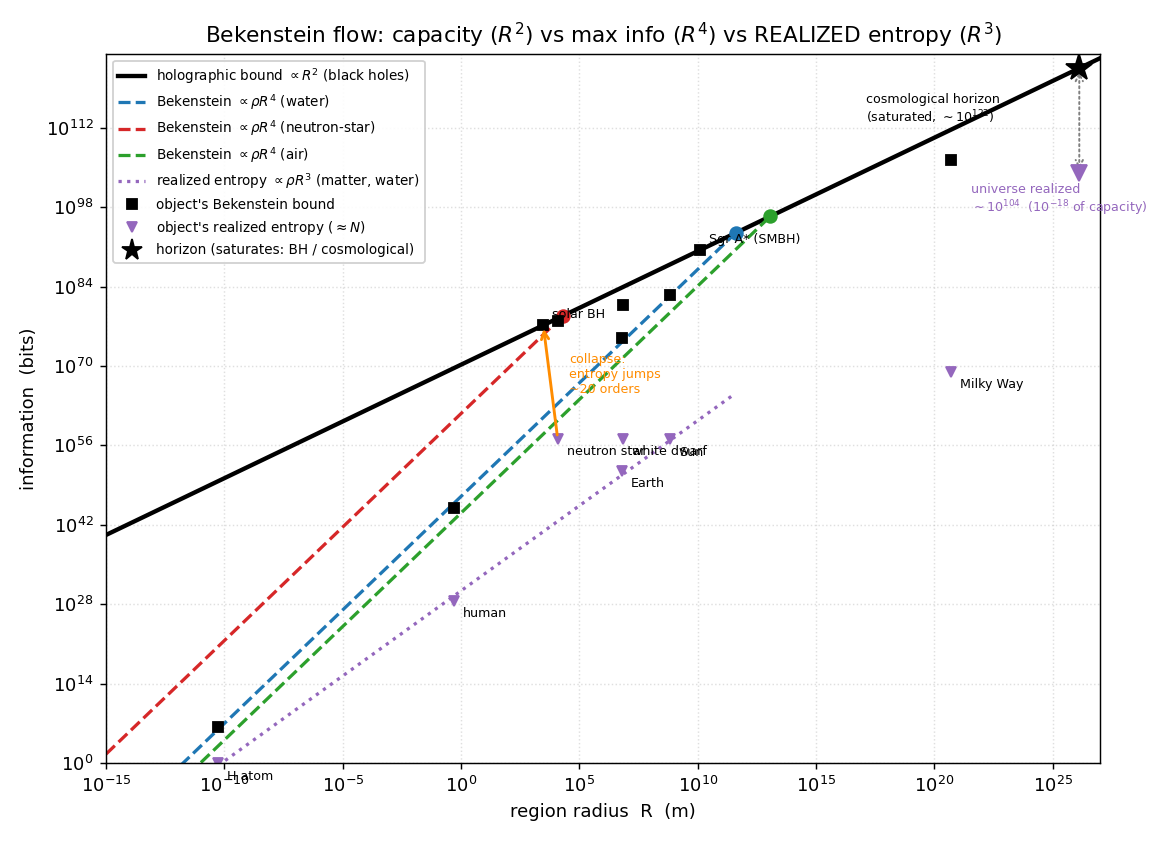
scripts/bekenstein_flow_plot.py; the R⁴ curve beyond Rs is a formal extrapolation.)
2. The cost of regional content:
To compare “how much information” two regional states carry, QIQT-H uses the Araki relative entropy of a state against a reference (the local vacuum). For a bounded region the local algebra is not the familiar Type I factor of ordinary quantum mechanics; in relativistic field theory it is a Type III von Neumann algebra. Araki relative entropy is already well defined there. The Type II “dressed” algebras — which carry a trace-like generalized entropy — come from the gravitational crossed-product construction of Chandrasekaran–Penington–Witten and Witten; QIQT-H borrows that picture as motivation, it is not something established here. The regional cost functional is
computed through Tomita–Takesaki modular theory: the modular operator , the modular conjugation , and the modular flow of the reference state. (Identifying this vacuum-relative distinguishability functional with the cost to instantiate regional content is itself part of the QIQT-H hypothesis, not a theorem.) For coherent excitations of a free field this reduces to an explicit one-particle expression, the Casini–Grillo–Pontello entropy , and this coherent-state reduction is what the Lean development checks, end to end, from the bounded modular operators to the entropy-reduction identity.
Scope. What is verified is the modular and relative-entropy calculus for the free-field coherent sector, the bookkeeping machine for χR. The verified part does not include the Type II regional construction itself, the (FQ) axiom, or the conjecture below.
3. The retired conjecture: macroscopic definiteness (H2)
The program’s original load-bearing claim — the Macroscopic Definiteness Conjecture — was that two or more distinct macroscopic records being actual together in a region would have joint cost exceeding the capacity , so finite capacity itself forces a single outcome. This is now retired as a category error (2026-06-15), and we record the retirement plainly rather than keep it as “the crux.”
Why it fails: a holographic bound counts independent degrees of freedom (joint entropy / code dimension), not a sum of redundant classical records — redundant copies of one fact carry joint entropy , not (machine-checked). Ordinary, weakly-gravitating record entropy is moreover capped at , parametrically below (only a black hole saturates , and it has no records); for the observable universe that is against — a permanent ~31-order gap. Even the total realized entropy (black-hole-dominated, ) is only of the holographic capacity. And the data-processing estimate confirms two records cost about one bit more than one, not an area-scale . Finally, by exact unitary linearity, finite capacity can neither forbid a superposition nor select a branch. So does not do the single-outcome work; it is the finite record stage (a cardinality bound). The single outcome is supplied by — the next section.
4. Single record — by selection, not by capacity
After decoherence has stabilized and proliferated the macroscopic records (making them non-interfering and redundantly objective), the content the region realizes is one definite macroscopic world — while keeps all branches and evolves exactly unitarily, with no collapse term. The single actual record history is supplied by the non-dynamical primitive-actuality selector , a modal single-history selection among the unitarily-evolved alternatives: actualizes exactly one globally-consistent record history, the other components staying present in the (ontic) as real wave structure but unactualized — not actual events or observers (a Bohm-inspired empty-wave picture, though is non-dynamical: no guidance law, and it marks a record-history rather than a configuration). Because has no back-reaction and the Born weights are the nomological measure over possible history-selectors, the scheme is operationally equivalent to standard (Everettian) quantum mechanics — is unobservable; its content is interpretive (a single actualized history), not a new prediction. The honest cost, owned: keeping all of real makes the unactualized components present-but-empty wave structure — the same “extravagance” charge critics press on Bohm’s empty waves — and , a nonsupervenient actuality fact, is itself part of the ontology (substance monism + primitive actuality, not ” alone”).
Where the exclusion really comes from. Since capacity does not forbid two records (§3), what makes a region’s actual content single-valued is just that a classical carrier holds one value — local single-valuedness — and which value is the actual one is supplied by λ. The Lean development machine-checks a finite, additive-cost counting bound (at most one member of a saturating family), an honest finite stage; it does not derive that capacity overflows on two macroscopic records.
This is worth stating carefully, because “one outcome” and “unitary evolution” sound contradictory. The global wave function evolves unitarily throughout; the single actual record is a selection by λ among the unitarily-evolved alternatives, not a dynamical modification of the Schrödinger equation — the (Φ, λ) account. Making that selection precise, and deriving its statistics, is the dynamical-realization and Born problem below. ’s role is the finite record stage (how many distinguishable records exist), not the selection.
Recent progress has made λ’s selection schema precise where it can be — machine-checked, axiom-free, at the finite, the one-particle continuum (the bounded modular flow ), and the second-quantized free-field (, a unitary group) levels. (We say schema, not law: “axiom-free in Lean” means no extra Lean axioms, not no physical postulates — those are the hypotheses below.) The records come from a chosen abelian coarse-graining associated with the Type III algebra (it has no atoms), and Takesaki’s criterion fixes which record context is consistent — the modular flow fixes a projection iff it commutes with the (faithful, reduced) state, , exact decoherence. The dephasing map is then the state-preserving conditional expectation onto the (generally nonabelian) block-diagonal algebra, and the Born weights are a genuine probability (on the Fock vacuum state the single-mode Weyl-bit effect gives ). One consistency result: the dephasing map commutes with the modular flow for every — no modular recoherence in the chosen invariant algebra. But the modular flow is not the physical Hamiltonian evolution (they agree only in special KMS / Bisognano–Wichmann cases), so this is modular-invariance, not a proof that real records never recohere under the actual dynamics.
The boundary as an open quantum system. A complementary, machine-checked layer models the region’s boundary as an open quantum system driven by a record channel: records provably form (a monotone obeying a second law, with a rigidity theorem), pointer-basis einselection is recovered at the time-averaged level, the equilibria are simultaneously stationary, stable, and Einstein-satisfying, and an exact Born-rule jump unraveling makes the Born weights forced by the channel rather than assumed ab initio. The residual input is the record basis the channel monitors — the same system–environment cut einselection requires. See the theorem index.
The selection event has an explicit constructor too (SelectionEvent.lean): an inverse-CDF selector
from an “actuality seed” picks exactly one record per seed (totality + uniqueness of a sampling
map), and the single-shot seed measure of record equals its Born weight . It adds no actualization
mechanism, and a single-shot measure is not yet an across-run frequency (that needs a product measure + a
law of large numbers). The selector is order-dependent, not equivariant (as the no-covariant-selector result
requires); the seed measure is order-blind.
Two honest caveats remain — now in their irreducible form. First, the construction reduces the whole selection to one datum: which seed is actual. The seed is λ — the one primitive a non-dynamical single-world theory must take as given; its origin is not, and arguably cannot be, derived. Second, the weights enter as an input here; deriving them as across-run frequencies rests on a premise the Born no-go proves unremovable.
5. Born statistics
That outcome occurs across runs with frequency is the Born rule. QIQT-H recovers it from typicality: over the measure of microscopic initial conditions compatible with a given preparation, the realized single-record outcome has frequency for typical initial data. Substantial progress is now machine-checked (axiom-free): a Lorentz-covariant, σ-additive, decoherent-histories-consistent Born measure on the free-field record net exists and is verified, and Born is reduced to a single state-supervenience premise — the content of postulate P5 (quantum equilibrium: a refinement-equivariant typicality measure) — via the Zurek envariance symmetry (proved) and an orthonormality bridge — with a no-go showing some such premise is unavoidable (naturality alone is not enough; refinement-additivity is what fixes the square). The probabilistic content is thereby isolated in P5: the residual is P5’s canonicity, not the Born rule itself. What remains: justifying that premise as forced rather than merely motivated, and the continuum/interacting realization. Born is an honest reduction, not yet a derivation from nothing.
The status, at a glance: (FQ) capacity postulate · area floor now a derived
theorem from it (P4-MICRO, axiom-free) · calculus machine-verified · free-field Einstein equations
machine-checked from the derived floor + a labelled Bisognano–Wichmann thermal input (gr_from_p4micro; capacity
alone ≠ GR) · H2 retired (category error — capacity does not forbid records) · single record supplied by
λ (selection postulate; covariance + contextuality + no-signaling machine-checked; dynamical-realization gap open) ·
Born reduced (axiom-free) to the single postulate P5 (quantum equilibrium). The whole development is axiom-free. The
formalization page documents exactly which pieces are checked; the
open problems page lays out the remaining frontier (λ’s law, the continuum).